
Releases • 5 min read
Douro by Glender: Where the River Remembers
Douro by Glender is more than a song about one of Portugal’s most iconic landscapes. It is a journey through the river, schist, terraced vineyards and the memories carried by generations along the Douro Valley. From the carved slopes of northern Portugal to the slow movement of the river below, Glender transforms landscape, time and belonging into the language of Afro House.
The Douro is not treated as scenery. It is the central character.
A river that has watched people arrive, work, love, leave and disappear — while continuing to move through the valley as it has for centuries.
A River Carved Into the Land
The Douro landscape is built from resistance.
Vineyards rise from steep terraces cut into schist. Villages cling to the mountainsides. Roads follow impossible curves above a river that has spent centuries shaping the valley beneath them.
There is beauty here, but never softness.
The land demands patience, labour and endurance. Every terrace represents human effort. Every wall of stone carries the marks of hands that worked long before the landscape became one of Portugal’s most recognisable images.
That tension lies at the centre of Douro: the contrast between permanence and movement, between the stone that remains and the water that never stops.
“Ó Douro, fio de prata no chão
Caminho de rocha e de perdição”
The river becomes a silver thread running through a landscape marked by work, distance and time.
It connects villages, generations and stories, but it also carries them away.
Giving the River a Pulse
Musically, Douro by Glender translates that movement into Afro House.
The production does not attempt to reproduce Portuguese traditional music literally. Instead, it absorbs the weight and rhythm of the landscape.
Percussion moves with the persistence of the river. Organic textures create a sense of earth and physical space, while melodic elements gradually open like the valley revealing itself after another bend in the road.
At 121 BPM, the track has a hypnotic, almost processional movement.
There is energy, but also restraint.
The rhythm is designed for the dancefloor, yet the emotional language belongs somewhere older. The electronic production does not sit on top of the landscape as decoration. It feels as though it emerges from the stone, the water and the silence around them.
This balance between contemporary club music and Portuguese memory has become increasingly central to Glender’s work.
The objective is not nostalgia.
It is translation.
To take something rooted in a particular place and allow it to live again through another musical language.
What the River Keeps
The lyrics of Douro are filled with things that disappear.
Wind moving slowly through the terraces. Vines leaning over schist. A boat cutting across the water. Names hidden beneath stones. Stories that no one remembers clearly anymore.
“Nas margens dorme o que ninguém viu
Cada pedra é um nome que o tempo cobriu”
This is where the song moves beyond landscape.
The Douro becomes an archive.
Every wall, vineyard, abandoned house and piece of stone carries traces of the people who were there before us. Their names may disappear, but something of their presence remains embedded in the territory.
The river witnesses all of it without judging and without stopping.
That idea reaches the emotional centre of the refrain:
“Ó Douro, espelho de um triste luar
Segues a vida sem nunca parar”
People pass.
The river continues.
It is this contradiction that gives the song its emotional weight. The Douro represents continuity, but everything surrounding it is temporary.
Generations change. Villages transform. Houses empty. Boats disappear. The land remains, carrying fragments of what came before.
Stone, Water and Memory
The visual world surrounding Douro follows the same language.
Schist, terraced vineyards, old boats, weathered hands and the river itself are not used simply because they are visually beautiful. Each one carries symbolic weight.
Stone represents what remains.
Water represents what cannot remain.
And somewhere between the two lives memory.
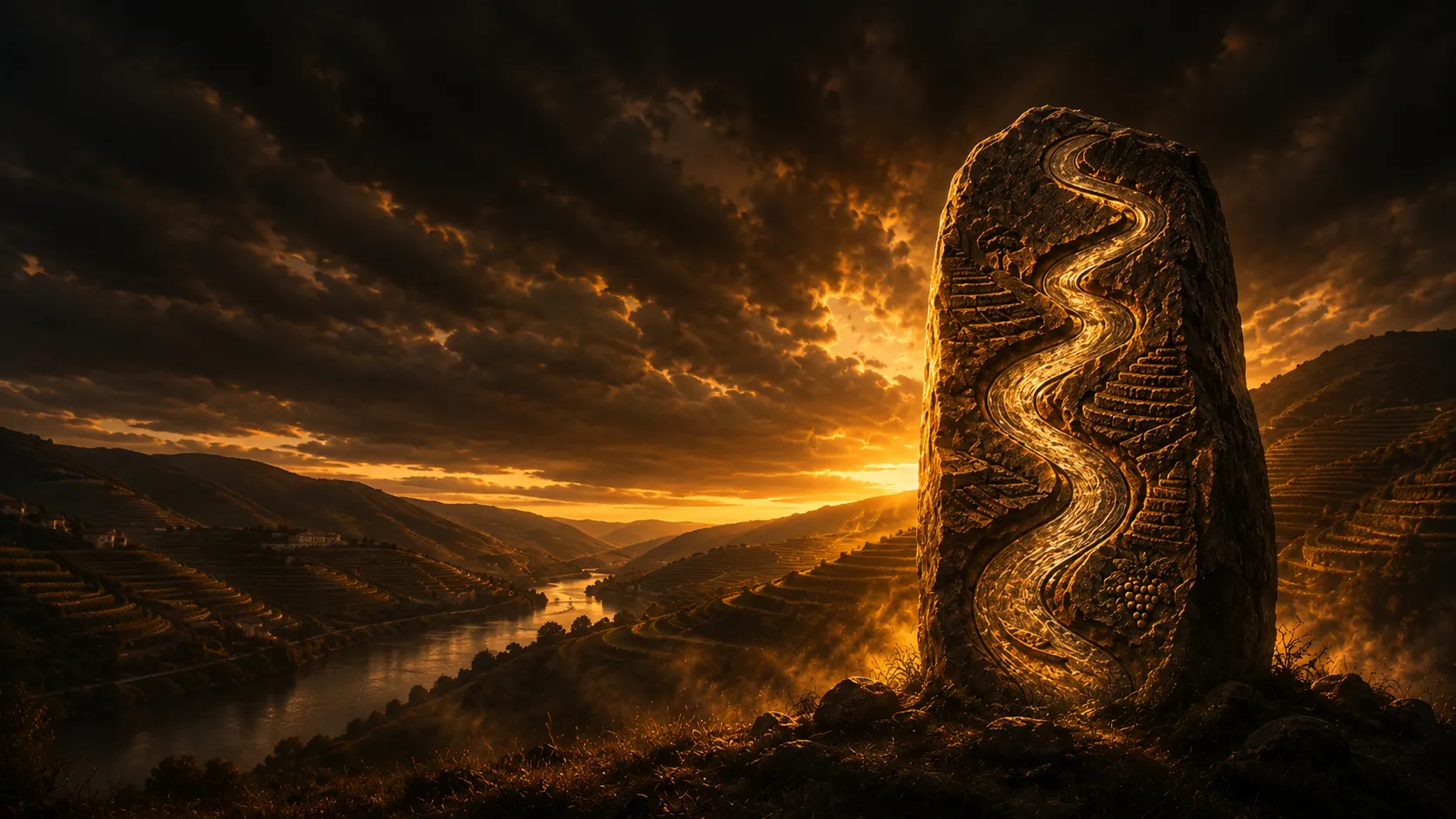
The central carved monolith developed for the visual identity of the release embodies that relationship. It feels ancient and immovable, while the engraved river running through it suggests constant movement.
The landscape is treated almost like a sacred document.
Not in a religious sense, but as something that holds knowledge.
The carvings, textures and marks evoke the idea that the land remembers even when people forget.
The visual language is dark, cinematic and restrained: deep charcoal shadows, amber light, drifting mist and the last warmth of sunset across the valley.
There is no attempt to turn the Douro into a tourist postcard.
The intention is to show it as something remembered.
Something lived.
Something that existed before us and will continue after us.
Portugal Through Electronic Music
With Douro, Glender continues an artistic direction increasingly focused on Portuguese territory, identity and collective memory.
The landscapes may change, but the underlying question remains the same:
What does a place remember?
In Canto de Xisto, stone carried the strength and severity of northern Portugal.
In Canto da Planície, the Alentejo became a space of heat, silence and endurance.
Now, in Douro, movement becomes the central metaphor.
The river connects all of these ideas.
It moves through geography in the same way memory moves through generations: never completely still, never entirely lost.
This continuing exploration of Portuguese identity places landscape at the centre of the composition. The Douro is not treated as background or as nostalgic decoration, but as a living presence shaped by generations of work, departure and return.
Its movement becomes rhythm.
Its silence becomes space.
Its history becomes part of the emotional architecture of the music.
Douro by Glender is ultimately about that connection between what changes and what remains.
The river flows.
The stone stays.
And between them, memory continues.
Douro is available now on all platforms.