
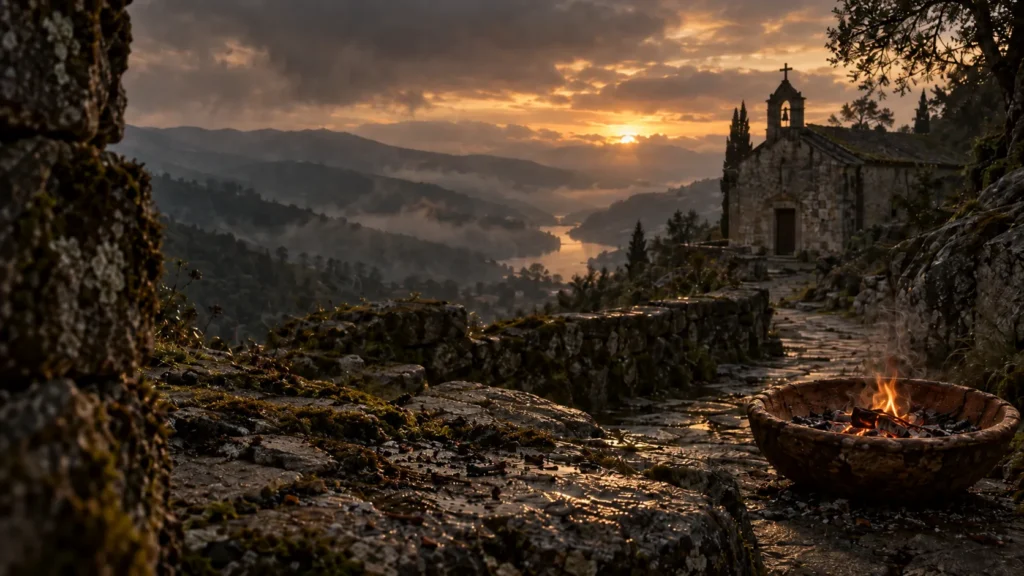
Releases • 5 min read
Chama Antiga by Glender: Where the Fire Waits
Chama Antiga by Glender is more than a song about an old love. It is a winter journey through cold ground, falling leaves, a bowl of ash and one small flame that refuses to go out. Across six short lines of chorus, Glender turns absence, patience and memory into the language of Afro House.
The fire is not a spectacle. It is a presence.
Nothing in this track burns loudly.
A Fire That Begins With Absence
Most songs about fire begin with heat. Chama Antiga begins with weather.
The opening verse describes cold moving along the ground, and something unexpected happens inside it. The cold does not take the name away. It carries it.
“Veio o frio pelo chão
Trouxe o teu nome até mim”
Then the sentence turns.
“Folhas caem, o tempo passa
Mas tu ficas dentro de mim”
Leaves fall. Time passes. Every verb of loss is present, in order, exactly where you expect them. And still, something refuses to leave.
That inversion is the whole architecture of the song. Winter is not treated as the enemy of warmth. It is treated as the messenger that delivers it.
Giving the Flame a Pulse
Musically, Chama Antiga translates that stillness into movement.
The percussion carries the weight of the earth. It behaves like a hearth rather than a stadium: low, close to the ground, patient, repeating without insisting. Organic textures create the sense of a physical space with a fire at its centre, while the melodic elements stay distant and open, more horizon than decoration.
At 120 BPM, the track has a hypnotic, almost processional movement.
There is energy, but no urgency. The rhythm is built for the dancefloor, yet its emotional language belongs somewhere older. Silence is used as an instrument here: the space between phrases is not empty, it is where the listener places their own story.
The chorus never becomes an explosion. Its return is the release, which means the reward of this track is not adrenaline. It is recognition.
The vocal treatment follows the same logic. The hook abandons language entirely and becomes percussion, a pulse made of open vowels:
“Aya, aya, aya ê
Tara, tara, tara ê”
When words run out, rhythm continues. That has always been the oldest instinct in this music.
What the Fire Keeps
The second verse moves from absence to recognition.
“Já te amava antes de saber
Já te ouvia antes de vir”
The line describes a love that precedes knowledge: a feeling already complete before any fact arrived to explain it. Most love songs move the other way. They meet someone, and then they feel something. This one feels something first, and spends the rest of its length finding out what it was.
Then the song draws its line.
“Há amores que o tempo leva
E há os que voltam a existir”
There are loves that time takes away. And there are loves that come back to exist.
That distinction gives the title its meaning. Chama antiga does not describe a new fire. It describes one that was already burning before anyone arrived to watch it. Older than knowing. Older than the person carrying it.
The chorus holds it there, in six short lines built around a single ordinary word.
“Fica, fica
Fica em mim”
Fica. Stay. In Portuguese this is not poetic language. It is what you say to someone at the door. It belongs to kitchens and hallways, which is precisely why it can carry a song this size.
The imperative matters as well. A plea asks a person to remain, and already accepts that it might fail. An imperative holds the thing in place while it is being spoken. Every time the chorus returns, the fire is being kept.
Ash, Clay and One Small Flame
The visual world of the release follows the same restraint.
The cover is a single room and a single bowl. A shallow vessel of fired clay sits on a cold stone floor. Inside it, ash: black, worked, exhausted. At the centre of that ash, one living flame, small enough to cup in two hands, with a thread of smoke rising from it. Dry leaves have fallen across the stone, and one narrow window lets a shaft of amber light into the dark.
The image and the first verse are the same sentence. The cold floor is “veio o frio pelo chão”. The leaves are “folhas caem”.
But the decision that matters most is the size of the flame.
A bonfire is a performance. It is designed to be seen from a distance, and it burns out quickly because it gives everything away at once. An ember is a relationship. It survives because it is small and protected, and because someone kept it fed without needing an audience.
The visual language is dark, cinematic and restrained: deep charcoal, selective amber, dust, clay, smoke and the last warmth of a winter interior. There is no attempt to turn fire into spectacle. The intention is to show it as something remembered.
Portugal Through Electronic Music
With Chama Antiga, Glender continues an artistic direction increasingly focused on Portuguese territory, identity and collective memory.
The landscapes change. The question stays the same.
In Canto de Xisto, stone carried the strength and severity of northern Portugal.
In Canto da Planície, the Alentejo became a space of heat, silence and endurance.
In Douro, water became movement: the one thing that continues after everything else has passed.
Now, in Chama Antiga, the element is fire.
Stone, horizon and water are all outside us. Fire is the one we carry. It is the only element that cannot be stored as itself, only kept alive, fed and passed from hand to hand. That is also the exact nature of memory: not an archive waiting to be consulted, but a flame that lives only while someone keeps moving it forward.
Chama Antiga is ultimately about what survives the cold.
The winter comes.
The leaves fall.
And the fire is still there, waiting.
Chama Antiga is available now on all platforms.